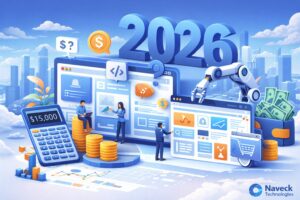
The software development landscape is currently undergoing its most significant shift since the transition from assembly language to high-level programming. We aren’t just talking about a new framework or a trendy library; we are witnessing a fundamental rewrite of the Software Development Lifecycle (SDLC).
In 2026, generative AI in software development has moved past the “hype” phase. It is no longer just about chatbots writing snippets of Python code. It is about autonomous agents managing deployments, AI-driven architectures that self-heal, and a drastic reduction in the “boilerplate tax” that has historically bogged down innovation.
At Naveck Technologies, we’ve seen firsthand how these tools allow startups and enterprises to leapfrog traditional development hurdles. This guide explores the architectural shifts, the evolving toolsets, and the real-world use cases defining this new era.
Why Generative AI Is a Game Changer for Software Development
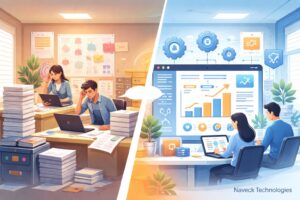
For decades, software development was a linear, labor-intensive process. A human thought of an idea, a human translated that into a technical requirement, and a human manually typed out every line of logic.
Generative AI software development introduces a “collaborative intelligence” layer. According to recent industry research, developers using AI assistants complete tasks up to 55% faster than those who don’t. But the impact goes beyond speed:
-
Democratization of Code: It lowers the barrier to entry, allowing founders to build AI MVP development for startups with leaner teams.
-
Cost Efficiency: By automating repetitive tasks, the custom software development cost is becoming more predictable and manageable.
-
Shift in Focus: Developers are evolving from “writers” of code to “editors” and “architects” of systems.
What Is Generative AI in Software Development?
To understand the shift, we must distinguish between Traditional AI and Generative AI. Traditional AI (discriminative) is excellent at classification—telling you if a piece of code contains a bug based on historical patterns.
In contrast, Generative AI uses Large Language Models (LLMs) to create new content. In the context of software engineering, this includes:
-
Code Generation: Writing functional logic from natural language prompts.
-
Synthetic Data Generation: Creating realistic datasets for testing without compromising user privacy.
-
Documentation: Automatically generating README files, API documentation, and inline comments.
How Software Was Traditionally Built (The Pre-AI Era)
Before the integration of AI-powered software development, the process was fraught with “manual friction”:
-
Manual Boilerplate: Every project started with hours of setting up environments, folder structures, and repetitive “plumbing” code.
-
Lengthy Debugging Cycles: Developers spent roughly 50% of their time finding and fixing bugs rather than building features.
-
Knowledge Silos: If a senior developer left, the institutional knowledge of a complex codebase often left with them.
-
Rigid Timelines: Scaling a product often required hiring more heads, leading to the “Brook’s Law” dilemma—adding manpower to a late software project makes it later.
For many, this is why outsourcing vs in-house development became the standard strategy to manage costs and talent gaps.
How Generative AI Is Changing Each Stage of the SDLC
The impact of generative AI on modern software development is visible across every phase of the lifecycle. It is effectively “greasing the wheels” of the entire machine.
1. Idea Validation and Requirement Analysis
The hardest part of building software is often defining what to build. AI in software planning now allows stakeholders to feed raw business ideas into LLMs to generate:
-
User Personas: Detailed profiles of who will use the software.
-
PRDs (Product Requirement Documents): Turning a 10-minute conversation into a structured technical roadmap.
-
Market Analysis: Quickly identifying if a feature exists in the market, helping founders validate and scale from MVP to market fit.
2. Code Generation and Development
This is the most visible change. Tools like GitHub Copilot and Cursor have turned the IDE (Integrated Development Environment) into a pair-programming hub.
-
Boilerplate Automation: AI handles the CRUD (Create, Read, Update, Delete) operations.
-
Legacy Refactoring: AI can take ancient COBOL or old Java code and suggest modern, cloud-native equivalents in TypeScript or Go.
-
Contextual Logic: Modern generative AI coding tools understand the entire repository, not just the file you are working on, ensuring that the code they suggest follows your specific architectural patterns.
3. UI/UX Design and Prototyping
Designers are no longer starting with a blank canvas. AI-assisted UI design tools can generate high-fidelity wireframes from a text description.
-
Instant Iteration: “Make this dashboard look like a fintech app with dark mode” can generate a design in seconds.
-
Code-to-Design Sync: Bridging the gap between what a web design company envisions and what a developer builds by generating the CSS and React components directly from the design.
4. Testing, Debugging, and Quality Assurance
Testing is usually the first thing cut when deadlines loom. AI-powered software testing ensures this doesn’t happen.
-
Auto-generated Test Suites: AI can scan a function and write the Unit, Integration, and End-to-End tests automatically.
-
Edge Case Detection: AI is remarkably good at “thinking” like a malicious or confused user, finding bugs that a developer might overlook.
5. Deployment, Maintenance, and Scaling
In the DevOps world, AI in DevOps is moving toward “Self-Healing Infrastructure.”
-
Log Analysis: AI can scan millions of log lines in real-time to identify a memory leak before it crashes the server.
-
Predictive Scaling: Analyzing traffic patterns to scale cloud resources up or down more efficiently than static rules.
Key Benefits of Generative AI in Software Development
Why are companies racing to adopt an AI-driven software development model? The business metrics are undeniable.
| Benefit | Traditional Impact | AI-Driven Impact |
| Speed to Market | 6–12 months for an MVP | 2–4 months for an MVP |
| Developer Focus | Spent on syntax and bugs | Spent on logic and UX |
| Cost | High (Human-hour intensive) | Optimized (High output per hour) |
| Code Quality | Variable based on seniority | Standardized through AI linting |
For those looking to build scalable software solutions for SMEs, these efficiencies mean the difference between staying relevant or being disrupted.
Real-World Use Cases of Generative AI in Software Engineering
-
Modernizing Legacy Systems: An enterprise has a 20-year-old banking system. AI helps map the logic and rewrite it into microservices, reducing a 3-year project to 1 year.
-
Rapid MVP Launches: Startups use AI to build investor-ready MVPs in weeks, allowing them to test market hypotheses with minimal capital.
-
Hyper-Personalized SaaS: Platforms that use AI to generate custom reports or user interfaces on the fly for each specific client.
-
Automated Documentation: Companies maintaining large open-source projects use AI to keep their documentation perfectly in sync with every code commit.
Challenges and Limitations of Generative AI
Despite the power of generative AI for developers, it is not a magic wand. There are critical risks that require human oversight:
-
Hallucinations: AI can confidently suggest code that doesn’t work or uses libraries that don’t exist.
-
Security Vulnerabilities: If an AI is trained on insecure code, it may suggest insecure patterns. A checklist for finding a software outsourcing partner should always include their AI security protocols.
-
Intellectual Property: There are ongoing legal debates regarding the ownership of AI-generated code and whether it violates existing licenses.
-
The “Junior Developer” Gap: If AI does all the “easy” work, how do junior developers learn the basics? Mentorship models must evolve.
Generative AI vs. Traditional Software Development: A Comparison
Is traditional development dead? No. It’s evolving.
When to use Traditional Development:
-
Highly regulated industries requiring 100% predictable, audited logic.
-
Deeply specialized hardware-level programming.
-
Novel R&D where no training data exists for an AI to learn from.
When to use AI-Driven Development:
-
Standard web and mobile applications (Web development company services).
-
Data-heavy enterprise tools.
-
Rapid prototyping and scaling startups faster.
The Future of Software Development with AI (2026–2030)
As we look toward the end of the decade, the concept of a “No-Code” world is being replaced by a “Natural Language Code” world. We are moving toward Autonomous Development Agents.
Imagine a system where you say: “Build me a subscription-based marketplace for sustainable fashion, integrated with Stripe and a custom recommendation engine.” The AI won’t just give you the code; it will provision the servers, set up the database, design the UI, and present you with a working URL.
In this future, the value of a remote software development team in India will not be their ability to type code, but their ability to prompt, audit, and orchestrate these AI systems to solve complex business problems.
How Businesses Can Start Using Generative AI Today
Transitioning to an AI-assisted software development workflow shouldn’t happen overnight. Here is a recommended roadmap:
-
Identify Low-Risk Tasks: Start by using AI for unit testing or internal documentation.
-
Audit Your Toolchain: Equip your team with enterprise-grade AI tools that respect your data privacy (e.g., GitHub Copilot Enterprise).
-
Invest in “Prompt Engineering” Training: Teach your engineers how to talk to the machines effectively.
-
Partner with Experts: If you lack internal AI expertise, look for a generative AI development company that understands how to integrate these tools into your specific business vertical.
How Naveck Technologies Helps You Navigate the AI Revolution
The shift to AI-driven development is complex. At Naveck Technologies, we bridge the gap between cutting-edge AI capabilities and stable, scalable software engineering.
We don’t just use AI to write code faster; we use it to build smarter. Whether you are looking to hire remote software developers in India or need a partner to build a successful remote development team, we integrate Generative AI at every level of our process.
-
AI-Enhanced MVPs: Reduce your time to market by 40%.
-
Custom AI Integration: We help you embed LLMs into your existing products safely.
-
Modernization: We use AI to breathe new life into legacy enterprise systems.
The world of software is changing. You can either be the one using the tools or the one being disrupted by them. India’s role as a global leader in software outsourcing is only strengthening as we embrace these AI-first methodologies.
Conclusion: Empowering, Not Replacing
Generative AI is not the end of the software developer; it is the end of the “code monkey.” By removing the drudgery of syntax and infrastructure, we are freeing human minds to do what they do best: solve problems, innovate, and create.
Are you ready to build the future?
Contact Naveck Technologies today for a consultation on how we can integrate Generative AI into your next software project.
Would you like me to create a detailed technical comparison table between specific AI coding assistants like GitHub Copilot, Cursor, and Amazon CodeWhisperer to add to this post?